
Most bathroom renovations are won or lost in the days after the site visit — and usually not on price. They're won on certainty, and on who gets there first.
Here's the pattern in almost every trade business: the homeowner books three visits. Three tradespeople turn up, measure, nod, and say "I'll email you a quote." Then the evenings disappear into spreadsheets, and the quote lands three, five, sometimes ten days later. By then the homeowner has cooled off — or someone quicker has already closed them.
The data on this is blunt.
Speed isn't a nice-to-have. It's the win-rate lever.
Two well-known studies have measured what happens when you make the customer wait:
- Harvard Business Review audited 2,241 US companies and found that firms which made first contact within an hour were nearly 7× more likely to have a meaningful conversation with a decision-maker than those that waited just one hour longer — and 60× more likely than those that waited a day or more.
- The MIT Lead Response Management study found that responding within 5 minutes versus 30 minutes made a business 21× more likely to qualify the lead. The same research pegged the average first-response time at 47 hours.
Bathroom renovations aren't web leads, but the psychology is identical: interest decays fast, and the first credible answer anchors the whole decision. Every day your quote sits unwritten is a day a competitor can climb into the gap.
Why "visual" beats "detailed"
A homeowner can't read a line-item spreadsheet. They can't picture 12 m² of "porcelain, rectified, matt." What they can do is react to a picture of their own bathroom with the new tiles, the new vanity, the new shower.
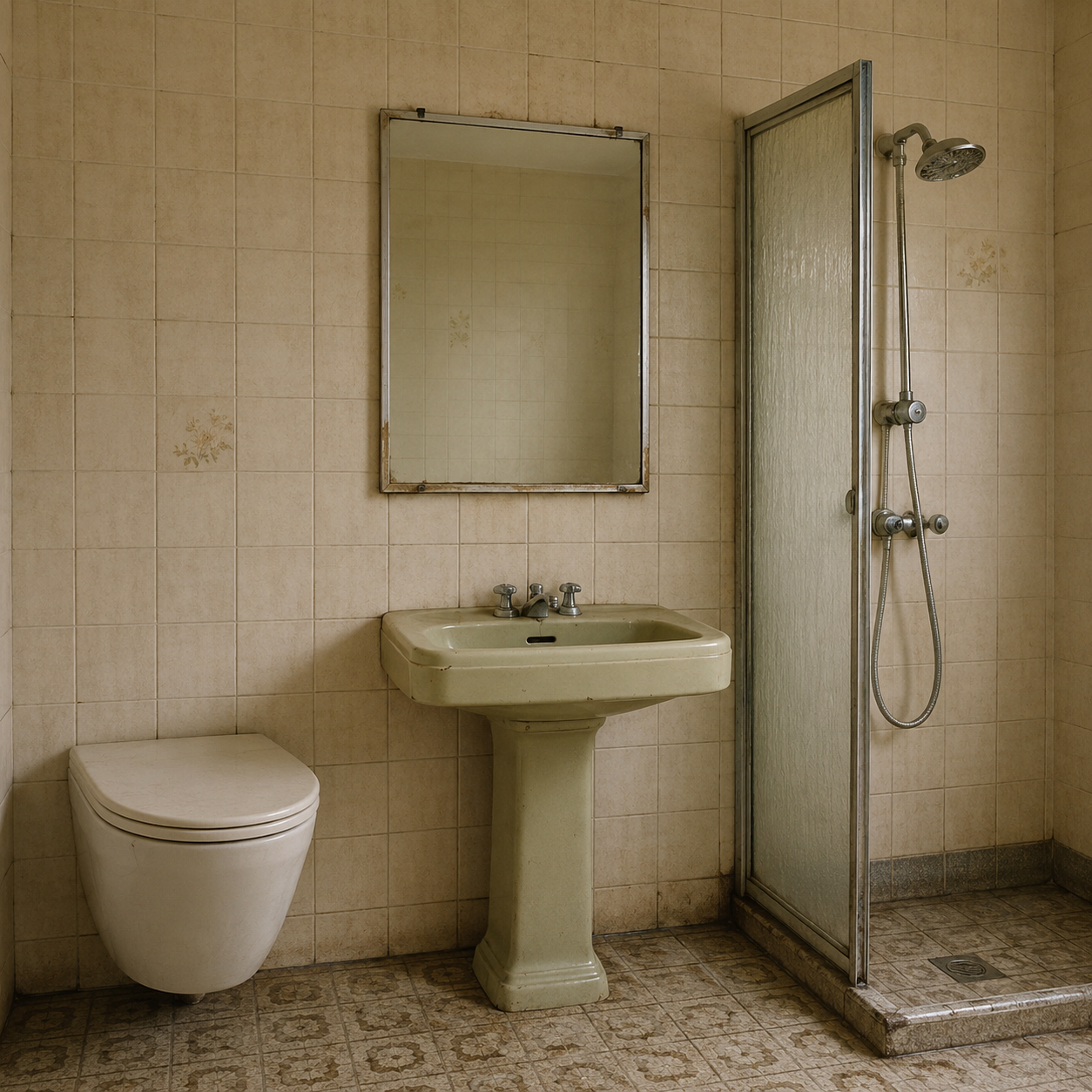 The starting point: a photo taken on the site visit.
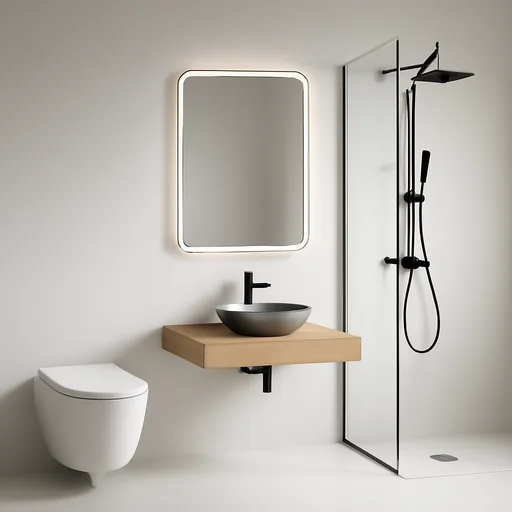 The same room, restyled with the chosen finishes — shown to the customer before you leave.
That visual does two jobs at once. It sells the outcome instead of the materials, and it makes the fixed price feel earned — the customer can see exactly what they're paying for.
A number on its own invites haggling. A number attached to a picture of the finished room invites a signature.
The 5-step on-site playbook
You don't need software to apply the principle — you need a repeatable routine. Here's the one that works:
- Photograph the room first, before you talk numbers. One clear shot of the walls and floor is enough. This becomes the anchor for everything that follows.
- Agree the scope out loud. Full strip-out and refit, or a surface refresh? Say it back to the customer so there are no surprises later: "So we're replacing the suite and re-tiling floor to ceiling — not moving the plumbing."
- Show two options, not five. A "clean and solid" option and a "premium" option. Choice paralysis kills decisions; a clear either/or drives one.
- Give one fixed price per option — on the spot. Not a range, not "roughly." Certainty is the product. If you price from real material costs plus a labour buffer, a fixed number is safe (more on that in how pricing and buffers work).
- Ask for the decision before you pack up. "Happy for me to pencil you in?" The worst outcome is a warm maybe that goes cold in the car park.
This is exactly the loop Mastro compresses into about five minutes — photo → render → fixed price → signature on the device — but the routine matters more than the tool. Do it by hand and you'll still beat the tradesperson who emails a PDF next Tuesday.
What "5 minutes" actually buys you
The goal isn't saving time for its own sake. It's collapsing the gap between "I like this tradesperson" and "I've said yes." When the quote is done on-site, that gap is zero. You walk out with a decision or a genuinely warm lead — not a to-do item for a tired evening.
Change one thing this quarter and don't make it your prices. Make it when the customer gets them.
Sources
- Harvard Business Review, The Short Life of Online Sales Leads (2011).
- Oldroyd, J., MIT Lead Response Management Study — response-time odds ratios.
Want to see the photo-to-signature flow end to end? Book a demo.